Main menu:

Site search

Sea fishing Categories

Fishing tips for beginners part 3 The Algae

The chemistry of sea water is a very complex mix of chemicals and compounds that are present in exact measurements depending upon where in the world you are. Many sea creatures absorb these chemicals to build there skeletons.

Macro Algae

The stuff that we call seaweed is not a plant; in fact it’s a macro algae. The importance of macro algae to the angler is it creates a safe hiding and feeding environment for hundreds of crustaceans and other small sea creatures, which larger species feed on. I also provides a safe home, out of sight from hungry seals and anglers alike.

Micro Algae

The green hue, or slime you see is a micro algae. This belongs to a group known as phytoplankton, which zooplankton generally feed on. This is possibly the most important part of the food chain, with the likes of Sand eel feeding on the zooplankton, Mackerel feeding on the Sand eel, Bass then feed on the Joey Mackerel.

The growth of algae is largely equal to the amount of available sun light and water temperature. The summer months see an increase in both and you will see an increase in the quantity of algae and the species that depend upon the food chain it creates.

The sea bed also changes as you move around the coast line. Substrates commonly found are rock, reef, shale, sand, mud, pebble, boulder and mixtures referred to as broken ground . The differing sea beds change the algae and fish species found and this needs to be considered when you are fishing.

Kynance Cove Rock and Beach mark

This delightful beach requires a good walk from the car park, down a cliff path to the beach below.

Species caught here range from Bass, Ray, Plaice and Dogfish and you can use most methods from different areas of the beach.

I have spent a lot of time spinning from the beach and find that dusk and dawn produce the best catches.

This is a popular holiday time beach, so bear that in mind.

Fishing tips for beginners Part 2 types of Marine fish

For a simple rule of thumb we can place the fish into two simple types, Round and Flat fish, there it couldn’t be easier……

Round and Flat fish

Round fish generally live in the Pelagic zone (from the surface down) and flat fish live in the Benthic zone (the sea bed into the substrate). So if you are fishing for flat fish you will want to get your bait on the bottom and round fish can be caught on the bottom up to the surface.

Cartilaginous Fish

But sadly it’s not quite a simple as that to truly classify marine fish. Sharks, ray, skate are all cartilaginous fish meaning they do not have a traditional skeleton and they need to be handled with real care when on dry land. Support their bodies and don’t hold them head or tail down as this will damage their internal organs. The snouts on these creatures are also very sensitive, packed full of nerve endings. Due to the fact they do not have any bone marrow; red blood cells in these animals are produced in the spleen, gonads and Leydig’s organ (not found in all cartilaginous fish). Many of these species will also give birth to live young, another reason for gentle handling.

Boney Fish

The others: Bass, Mackerel, Plaice etc have a more traditional skeleton and breed in a more typical way. However, Plaice for example start life looking like a round fish and as they quickly mature their eyes move around their heads and they take the familiar look of a flattie!

Marine fish

There are many thousands of species of Marine fish which have adapted to living in differing environments. Some like the many species of Wrasse have developed powerful jaws and teeth to rasp molluscs of their hold fasts. Pelagic predators including: Bass, Mackerel, Pollock and Cod are streamlined for speed and surprise attacks, and they have very large mouths easily engulfing their prey. Most of the flat fish use camouflage to spring a surprise attack on their victim, hiding partly covered in the substrate. Mullet have adopted a flat head with an almost upward pointing mouth designed to sip things out of the surface layer. These factors are very important considerations to the angler as it will dictate the methods required to catch these fish, and show opportunities not well explored by some anglers.

Perranuthnoe sea fishing

Heading back towards Helston from Penzance brings you across this fishing beach. A lovely mark with a great sandy beach! Lug and fish baits work well in this area for Bass, Dog fish, Ray and Turbot.

The locals comment on how well this beach fishes on a low tide, bucking the normal trend.

Saltwater fly fishing blog

I have been looking around the web at some interesting fishing blogs and I found this one. Its a very nice site with good quality information and plenty of advice and images.

This post show what can be achived with skill and determanition - Pollock on fly

Let me know your thoughts on that catch - Impressive??

Marazion beach fishing

This long strip of sand runs from Marazion across St Michael mount to Penzance. The Penzance end has some tunnels running under the railway line and fresh water comes out of them attracting all sorts to the beach, especially good for Bass. Towards the Marazion end of the beach the ground becomes a bit more broken and it looks very tempting.

The beach holds Sand eel and Lug worm and these are the favourite baits for this area. Species caught include Bass, flat fish, and Dog fish.

Fishing tips for beginners Part 1 the Marine fish

I would like to explain how a Marine fish, those that procreate and live in salt water survive in thier sodium saturated environment. Most Marine fish are always at risk of dehydration and they have some interesting mechanisms to combat this.

Osmosis and its effect on fish

The process of osmosis is in action all across mother-nature, including inside your body. It relates to how molecules pass through a semi permeable membrane in a solution. To think of it simply it’s a filter, where the larger molecules are kept on one side allowing the smaller molecules to pass through. Things in this world strive to be in balance, and the stronger solution of sea water wants to be diluted by fresh water.

This process happens across a large amount of the body surface of a fish, including the gills and gut. Fresh water is striving to leave the fish, capturing salt inside the fish’s body. Saltwater fish use their kidneys, and they have specially developed glands in the gills to deposit the salt. This process is called Osmoregulation.

There are fish that interest us Sea anglers that can live in many environments: Fresh water, Salt water and Brackish water, Flounder and Salmon come to mind. This is managed in differing ways. Some fish have glands that can excrete either fresh water or salt depending on the environment, others do not have a semi permeable skin, hence resolving the problem.

Applying Osmosis to fishing

All this science has some practical applications for anglers, most of which are common sense. For example a gold fish used as bait will die quickly! But it also effects how Marine fish may react in heavy rain fall, when the salinity of the sea close by to estuaries dramatically falls making an unsuitable environment and the fish will move away. The applications for this are endless and worth considering before you go fishing, don’t just consider the species you are targeting, but think about the food stuffs your target species hunt and how they may be effected.

Sea fishing, the beginners guide starts tomorrow!!!

As promised, I have written a very basic sea fishing guide. It’s here for you to comment on no matter what your ability to improve the quality of the information from your own experience. If you have any images that would help explain any of the information please send them to - [email protected]

There will be new posts every Monday and Thursday until Chrictmas Eve, starting tomorrow. You can subscribe to the latest information from the fishing blog via RSS here - Fishing feed

I hope you enjoy the mini series, its been a challange writing it and please, please comment to improve it!!!

Thank you.

Sophie lea - Charter boat in Essex

This is the latest addition to the www.englishfishingguide.co.uk Sophie Lea is a powerful and fast Charter boat based in BRIGHTLINGSEA in ESSEX. Offering some great Tope and Ray fishing as well as Bassing and winter Cod and Whiting.

The boat offers comfort to the higest degree, with a heated cabin to use while you are steaming and toilets! Live bait is available if required as well as some fishing equipment. This boat is able to offer fishing in most conditions as she is based on the Thames Estuary and can fish while others are still stuck in port.

For more information or to book with the skipper have a look here - Charter fishing on Sophie Lea

Penberth Cove

This is a mark I have not fished. I understand you need to park on the road side and walk down to the cove. The best mark is apparently along the coastal path to the right hand side of the beach where you should find a group of flat rocks to fish from.

The mark is good for Pollock and Wrasse and the rough ground after dark produces Conger and Rockling.

Porthcurno rock fishing marks

One of the most talked about fishing marks in West Cornwall and one I have fished a few times and intend kayak fishing next season.

This is the location of the renowned Minack Theatre, carved from the granite!

If you park in the beach car park and head out on the cliff path you will see a few areas that can be fished from. The mark at the far end seems to go into deeper water and produces the best mackerel fishing. All the other marks can produce a whole range of species including, Pollock, Wrasse, Turbot, Gurnard and Bass.

I have found the mid section to produce more Bass for some reason.

Flounder fishing session

I managed to get a quick session in yesterday and I put everything I have told you about flounder fishing into practice on a local mark and fishing hard in the mud gullies I managed to catch this great brace of Flounder.

The weather was mixed yeaterday, showers and a cold breeze was blowing. The tide was low at about 10:00 hrs and I got to my mark with fresh rag worm right on low tide. I checked for the gullies I thought the fish would use to navigate to the fresh mud and made a very simple running ledger rig witha 1/4 oz ball bullet and a size 1 long shank hook. I decorated the rig with a few sequins and pink and green beads, 5 in total.

The initial flood started and the water was gin clear and no fish were moving, then as the tide reached the midway point the water became cloudie and the fish started to feed. The first fish I had was this lovely school Bass. It was returned safely to the water, not thrown back in as I see to my anger so many times!! After the Bass came the first Flounder. It was a very gentle bite, drawing the rod tip towards the water twice, then still. I gave it time to mouth the bait and tightened the line into the flounder.

The second fish took a little longer to come. I had to really work the gullies, allowing the wind to catch the line to move the bait around, helping to hunt the fish out. I could see in the shallow spots the tide was catching the beads and making them sway in the current. It looked a very attractive and well presented bait. I was threading one worm onto the hook and then just nicking the other in the head, allowing it to dangle from the hook and flow in the tide. This proved to much for the flounder and I caught the second.

It was time to pack up and I headed for home very happy with my result. 2 fresh Cornish flounder and a great few hours sea fishing.

Rock fishing mark, Pendeen Watch

Head out of St Ives towards Lands End and follow your map to Pendeen Lighthouse for some great sea fishing. Park your car up and head off down to Portherris Beach or fish the rock marks underneath the light house.

The typical rock species including Wrasse and Pollock are fished for and from the beach good Bass are often taken.

The rock mark needs to be treated with care and is for the hardcore amongst you!

Fishing tips for beginners an introduction

I have been considering this for a while, a beginner’s sea fishing series, but I am unsure if the winter is the best time for it or not. Having reflected on this for a while and with Christmas dawning soon I have decided it’s a good time for you to ask for some fishing tackle as Christmas presents to get you started later in the year.

I guess you are asking why winter is not a good time for beginners. Well, my reasons are as follows.

  1. Its cold and you need expensive protective warm clothing
  2. The best fishing is often in rough weather and sea conditions. This requires heavy weights and good casting abilities
  3. You will likely loose more gear
  4. When the going gets tough, the cold makes it tougher

So far you can see the seasons will be effecting the type of Angling you do. This is because different species come to our waters at certain times of the year, generally dictated by water temperature.

I will attempt to guide you on what methods you can try to give you the best chance of success against easier species, generally during spring and summer. The idea is that you will get a feel for catching, playing and landing fish as well as develop the bug. This enthusiasm can then be channelled towards more challenging species and a greater investment of time and money can be spent in your new found hobby.

I need you to get involved by asking any questions by commenting on the posts, or if you are a more experienced angler please add things you think have been missed or expressed badly! That’s the beauty of the web, it’s a work in progress – not fixed like a book.

Over the next few weeks I will publish a series of beginners tips, methods and ideas to help you catch more fish and understand more about sea fishing.

Shore fishing marks

I get alot of people visiting the site looking for shore fishing marks.

I would like you to help me please in building a data base of shore marks around the UK. I have good knowledge of Devon, Cornwall and Dorset but I would like to offer many more fishing marks around the UK.

If you can help please comment on this post and I will use it as an article for others here. I cannot offer anything more than a link to your own site, if you can help me out.

The inofrmation does not have to be a work of art, but contain the basic facts of the location, species and any other tips and hints you care to add.

Thank you for your help.

Your opinion on Sea fishing

I wrote, what is proving to be a popular article on Sea fishing a few weeks ago.

I don’t know if I covered all the bases and if it is a true reflection of our sport?

There are Millions of people across Europe practicing sea angling every day and I would like your thoughts and opinion on how the article could be improved and better reflect us all.

River black with Fish

I went for a walk today along the river Cober, in Helston. I was amazed at the sight I saw.

The river was black with fish for an area about 40 feet long. It looked like I was looking into a stock pool at a trout fishery.

There were a few of what looked like Perch amongst the Trout but I am not sure why they are gathering like this at this time of year. I thought that most spawning was done in the spring. Have you got any ideas? let us know please………………

Flounders in Porthleven Harbour

I was hoping to fish the inner Harbour from the wall over the past few days but so far I have not managed.

Speaking to a few locals people have seen Flounder comming in over the Bar into the inner Harbour at low tide.

The fish seem to hold in the deep pool at the opening waiting to enter the Harbour area to feed heavily on the spoils of the low tide. Its a great mark to fish and well worth a bash!

It just goes to show how they use deep pools and gullies to get to areas as soon as the water floods as I explained over here - Flounder fishing

Christmas gift ideas for fishermen

You are going to hate me for mentioning that dreded word already and you know you have everything you need in your tackle box, well maybe sombody out there has somthing you haven’t got. With this in mind I would like to build a list of presents you would like for christmas relating to sea fishing.

You only have -

The idea is to get a list of popular gear and more unusual gear to help people who don’t really know what they want or need! and to help those poor people searching on christmas eve to find you a christmas present you want and not just a new pair of socks.

Essential Christmas presents for sea fishing

  • New multiplier
  • Braid
  • Rapala J11
  • Floatation suite
  • Polaroid shades

Nice to have Chrtistmas presents for Fishermen and Woman

  • Fish smoker
  • Fishing Kayak
  • GPS
  • Fish finder
  • Delux rod holder
  • Big game fishing holiday in the sun

Let me know by commenting on this post what you would like for Christmas and help build a huge list to help each outher out in this stressful time!!!

Spring clean your fishing tackle box

Having just moved house (without an internet connection !) I have been in a great position where I have been able to spend time getting rid of rubbish, loads and loads of it! What has this got to do with sea fishing? Well read on.

You fish every chance you have got, you get home and pack your gear away – damp, dirty and disorganised. You look in the bottom of your tackle box and there is a red hue in the corners from rust. Your tackle has a sticky coating, salt! All in all your gear is a mess.

What you need to do is give things a damn good clean out, throw away all those rusty hooks - they just pass rust around, they have no point and are no use to you. While you are doing that check your lures, change the split rings and trebles (when I dispose of hooks I cut the point off and take them to the dump).

Beads that are tainted or bleached might as well go, old nylon fishing line becomes brittle, tubes for booms break, the list is endless. You need to be ruthless and get rid!

Why is this so important? Well, to increase your chances of hooking and landing fish you need fishing tackle to be in tip top condition. Hooks sharp, line strong and your whole rig in perfect working order. Loosing a fish because your tube boom is split and it cuts the line is no-one’s fault but your own.

I know of lots of fish that have been lost because of old tackle. It’s a shame to think you have spent hours upon hours to locate fish only to loose it because of you faulty tackle!

Beach Casting for Cod

Winter is on it’s way and the nodding Cod will be on our shores soon and making good sea fishing sport. In fact in some areas Cod are being caught now by beach anglers.

The general rule of thumb is that Cod come closer to the shore and in range of beach casters when the light goes or the sea is well coloured. This should tell you that the fish are not using vision to hunt their quarry. Scent, touch and feeling for vibration are the tools of the trade, now you know how to fish for them. You need some local advice to find what tidal conditions produce fish in your area. Try large springs first then experiment if this does not produce Cod.

Assuming there are Cod on your mark and with the knowledge of how they will be hunting lets look at how to entice them to our baited rigs.

Scent trails for Cod.

This is the most popular system used for Cod fishing, even if you don’t know you are doing it. BIG baits are good Cod baits and BIG baits create big scent trails, simple!

Fresh fat lugworm dug from your local patch are often considered the best Cod bait. Other popular baits for Cod are Squid, Crab, Razor fish, Mussel and oily fish.

Why not consider using a ground baiting system to attract Cod and get them on the feed. I have used PVA bags full of bread and mashed mackerel to attract them but there are many other methods you could consider and try!

Hunting by Vibration.

As we know fish have the ability to hunt by sensing vibrations in the water. The easiest way to create an attractive vibration is through the use of live baiting. The current edition of Sea Angler follows Shane Pullen who goes to catch Cod using livebait – its well worth a read.

I have never tried using spoons when beach casting for Cod and I cannot remember reading much about it being tried but its worth ago!

Cod use Touch

Touch is really the last method you want to use. You are fishing by chance if you catch Cod by them coming across your scentless washed out bait. It will work if a Cod happens across your bait, but what is the chance, thousands of acres of sea, a few Cod and your bait!!

Remember though that if your rig is a mess, there is a chance that a Cod will be attracted to your bait only to be put off, or not well hooked because the touch and feel is not right – just consider it!

In conclusion

Again do your homework on the mark you plan to fish, prepare good quality bait, sharp hooks and well tied hooks. Balance your tackle to the requirements of the mark and remember,

1. Cod come close in in the dark or colored water
2. Cod hunt by Scent in the above conditions
3. They also use vibrations
4. Lastly they use touch
5. Use trial and error to learn the best system for your mark
6. Consider the conditions you are fishing in
7. Experiment with rigs, bait and casting ranges

I would love to hear any other ideas you have to catch more Cod from the shore.

Fishing exclusion zones

We already have Sea fishing exclusion zones around the UK. The first one that comes to my mind is the Bass nursery in the Helford river, here in Cornwall. To the best of my knowledge, this area prevents you taking Bass from a boat to allow fish stock numbers to increase.

I have also read that there is discussion about creating a 1 mile exclusion zone around the UK for commercial fishing boats. The effect of a ban like this would be two fold. Firstly the underwater environment would start to heal, habitats would flourish and this would encourage stocks of prey animals. The secondary effect would mean fish stocks could re-group and numbers build. The other environmental impact would be conservation of the hidden depths of our shoreline. It seems in my sceptical mind that money is invested in the disasters we can see - hedgerows, moor-land, wooded areas etc, but little or none in the areas we can’t see!

Many areas around the world have sporting sea angling, with high populations of fish attracting sports fishermen with big money to the their shores in order to enjoy top quality angling. Looking around Cornwall, I see money being invested in beaches to improve the facilities for the surfers and bathers. Estuaries and ports have huge investments of cash providing facilities for small boat users. Even birders have hides and wetlands created so there visual quarry can be seen more easily and the bird numbers are more plentiful. Why is this not happening for anglers?

I realise the best solution is a global one, but we could start to do things to improve our fish populations and make the UK seas into a desirable sports fishery. Investment into the sport would snowball and more and more money would come back in return. There would have to be a lot of changes and the sea angling licence would be one way of getting that initial money. Maybe would could police it in some way with voluntary wardens who could check licences and bag limits and report those who break the rules to the authorities - Just a though!!

Let me know your thoughts on creating a viable sports fishery here in the UK

Sea fishing

I realise this is a very basic level post about Sea fishing, however some readers here have asked for a basic explination of what exactly sea fishing is. Its really kind of hard to define, but I have attempted to cover most of the bases.

Sea fishing is the art or practice of catching wild fish in thier natural environment. Rod and line fishing has gained in popularity over the years and is now one of the largest sports in the western world, with sea angling making up a large percentage of anglers.

You are not restricted to the open ocean. Fishing in an estuary is also generally considered as Sea fishing. In fact many popular species are found high up where the salt water meets with fresh in rivers. Species including Bass, Flounder, Mullet and Bream are regulary caught in esturies across the UK.

The main niches of Sea fishing are,

  • Shore fishing
  • Boat fishing
  • Kayak fishing - I include this as seperate to boat fishing as its almost a halfway house between shore and boat fishing.

There are many techniques available to sea anglers whether you are fishing from the shore or a boat and depending upon which species you intend to target including,

  1. Beach Casting/up tiding (ledgering) - Casting baited fishing tackle from the shore line / boat into the sea.
  2. Lure fishing - Using plugs, rubber eels, spinners etc as an artificial attractor to catch fish.
  3. Fly fishing - The use of artificial generally hand tied lures to catch sea species.
  4. Float fishing - Thhis method can be used in many situations and it allows alot of groound to be covered, its also a very exciting method of fishing and often not used to it full potential.
  5. Kite fishing - not a widely used technique in the UK. It allows long range shore fishing and for alot of ground to be covered.

The fishing tackle varies from one method of sea fishing to another, but the basics are Rod, Line and reel. The sky is the limit when it comes to tackle choices and other equipment. There is now a massive range of accessories available, some gimmicks, some fishing equimpent to make life more comfortable like beach buddies (light weight shelters) and important safety equipment like floatation suites. I would guess that you could set your self up with some basic tackle, for light shore fishing for about £150. This would not include a set up for all occasions and weather!

You can start Sea fishing as soon as you are old enough to hold a fishing rod and wind the handle. I caught my first cod aged about 3 and I have not looked back since. I would suggest that 7 - 9 is a more typical age as patients and a bit of strength is required in most situations. Here is a post about the day I took my 4 and 6 year olds boat fishing

There is a wide varity of species available to you, many of them a dependant on the season. For example the Mackerel are now leaving our shores, but the Flounder are now comming into the esturies and many areas of the UK should be seeing Cod come from the beaches soon.

Basic considerations in matching your fishing tackle to your species should include the type of fishing, the tidal currents, the conditions you expect to attract fish to your location, the distance the fish are from you. The more balanced your tackle, the more enjoyment you will have!

Bait used for sea fishing includes almost anything found in the sea, and other food stuffs as well. Bread for example is a popular base for Mullet fishing. Earth worms have produced good flounder when they in the boundray of salt water and fresh.

My ethos is just to go and try. There are no hard and fast rules, and if you experiment and test you local water from the shore or boat you will learn about the location and discover what out-fishes other methods. Try using ground bait, experiment with unusual baits. Most importantly enjoy your sea fishing.

Porthallow Kayak fishing session

RTM disco fishing kayakDespite moving house and having loads to do at home I managed a fishing session on the Kayak, out of Porthallow using live sand eel, targeting Bass.

Having spent a few hours on Wednesday in my local tackle shop, I heard that Bass were falling to live sand eel. Bottom fished from the shore was the most popular method, resulting in 2 x 7lb Bass being caught from Loebar Nr. Helston in the past few days. The technique they used for these fish was a ball bullet on a flowing trace fished about 40 - 50 yds out. This method allows the sand eel to cover a lot of the sea bed, finding the holes and gullies holding the Bass.

The tide was small on Thursday, high at about 10:50 hrs and the weather was very fine, no wind and no swell. I managed to get to the tackle shop at opening time and was en-route with a bubbling live bait holder full of eel. My anticipation level was really high, combined with being stuck in the house for the past month, I really thought this was it!

I arrived at the beach ready to go sea fishing. I always pay to park and drop in an extra few quid as I am launching my Kayak from there, it’s an honesty box system.

I then have my system which allows me to get everything right and not forget things (generally),

  • Straps off the kayak and rolled ready for re-use on my return.
  • Kayak off the roof and either on to it wheels or carried to the waters edge.
  • Check the Kayak hatches and bungs are secure and well fitting.
  • Carry fishing gear, paddles, leashes, bait, GPS to Kayak.
  • Get changed, put camera phone and car key in water proof holder.
  • Pick up fresh drinking water and snacks.
  • Sun lotion if required.
  • Check safety gear is working.
  • Check car is secure, hand brake applied.
  • Put on PFD, lock car and go fishing.

Just a quick tip - I always, on finishing the trip put the Kayak onto the roof while in my wet gear. There is nothing worse than getting warm and dry, then getting soaked lifting the kayak onto the roof and getting covered in water (trust me I have done it).

I paddled out 10 yds and rigged up my rod. I am not sure why I don’t rig up on the beach, but these few minutes bobbing about allow me to find my balance and I seem to find I get on like this much better, feeling the shape of the water and getting into the groove.

I started by heading to some rough ground towards Porthkerris. I fished a simple bottom rig as describe above, hooked up my sand eel and started to drift. The drift speed was very slow and I did not cover much ground. Small Pollock fell to the live eel but, I could not entice anything else to the bait.

Getting a bit bored, I moved closer to the shore line. Bass like to hunt gullies and rough ground close to the shore line. I changed the rig to a bubble float with a 10 ft 14lb fluro carbon leader. I set the float about 2 feet from the end of the main line which meant the sand eel was fishing 12 feet from the bottom of the float. I dropped the rig into the water then paddled about 30yds away from the gear and drifted along the shore line in about 16 to 20 feet of water.

The water was very clear and I could see small wrasse and Pollock moving along the edge of weed beds over clean sand. Mullet of about 3 - 5 lbs were also cruising these weed margins. In fact the Mullet looked very interested in me and my Kayak, coming out of cover to have a better look at the hull of the boat. I thought one mullet was a Bass until I saw it flat nose which clearly distinguishes it from a Bass.

This method worked, but as I have found all year I could only manage small Bass in the 1 - 2 lb range. Nothing worth keeping but good sport. I experimented with the presentation of the Sand eel. Hooking it through the tail end made for a more lively bait with great action, but missed takes. Looking closely at the eels hooked this way I could see damage to the head end of the Sand eel. I then tried a couple hooked in the middle of the eel. I often notice that Bass caught on plugs are hooked on the central treble, but this was not reflected when using live bait. The best location for the hook was as close to the mouth of the eel as possible. I think that the Bass will take hold of a pray item however is easiest at the time, generally from underneath and towards the mid to front area but, when they mouth the bait, ready for consumption, they arrange the fish so it can be swallowed head fist. Hence, preventing fins and body appendages from fouling the mouth and allowing for easy passage down the throat.

I moved location after learning a lot from this area. The tide was now falling rapidly and the weather was still fine and the sun was now hot! I moved to the side of the cove where the prevailing light breeze was blowing towards and the tidal current was flowing. The reason for this was I hoped that any food stuffs would be carried to this area, and the bigger fish may be hunting in this location. I was wrong (again)!

My drifts were short, which I was prepared for because both tide and breeze were on shore. The sea bed is similar, more clean sand and fewer boulders but I saw less and hooked less. I did catch a nice Pollock which I wanted to return but sadly the fish had taken the hook very deep and had damaged its self, so I decide to dispatch it and took it home for the freezer.

I moved along the shore line to a distant headland, looking for deeper water close in shore. I only had about one hour of fishing left by now. I was fishing a deep hole I found and suddenly my rod bent over hard, then eased and the tip was nodding - A Cod! I started to reel in, not pumping the rod but keeping nice even pressure all the time. The fish became lighter and easier to pull in and I got my first sight of it. I could see a deep red colour coming towards me, aah cod from kelp I thought. At that exact time I could then see my Cod was in fact a Cuttle fish. His skin was bright red and sticking up in mini spines created by the millions of muscles in this fascinating animals outerlayer. It was not happy to see me, but it was beautiful and a first for me!!
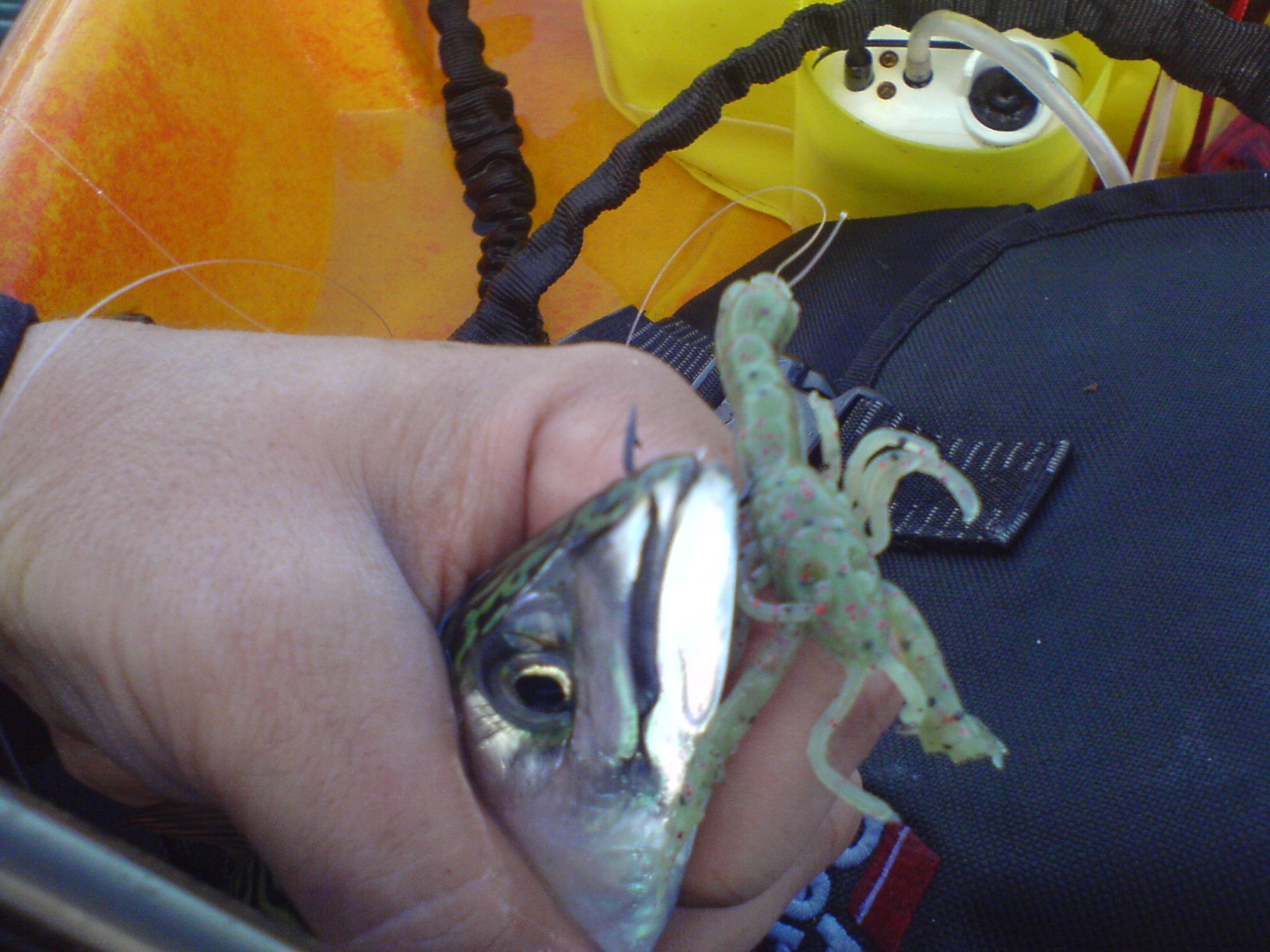
Mackerel from kayakIt was now time to make for port and head home. I replaced my sand eel for a Power Bait cray fish lure and dropped the rig to the bottom and started towards the shore. No more than 10 strokes and I was into a Mackerel. I started again and I was into another Mackerel. They loved this lure and watching it fall from my hand towards the sea bed I could see why. It had a lovely motion and fantastic reflective quality. I had about 10 Mackerel before I had to give up and just go straight back to the shore.

On arriving shattered at the shore line, I proceeded to dismantle my fishing gear and start storing it away in the car, not forgetting to place the kayak onto the roof before getting out of my wet suite.

In all it was a successful fishing trip at this interesting mark. A few lesson were learnt and I look forward to using this information on my next fishing trip.

I would love to hear about any lessons you have learnt recently on a fishing trip, do you experiment while on a session? Let us know by commenting on this post.

Save your life and buy a floatation suite for winter sea fishing

Save your life and buy a floatation suite for winter sea fishing.

Winter is creeping around the corner and people are getting excited about the winter species making their way closer to our shores. Hooks are sharpened and new rigs are being carefully tied. You invest all this time and money into your fishing tackle but your safety is the most important thing.

One of the most productive times to go fishing is just after a storm. The swells are still running, the sea temperature is cold and I guess the tide will be flowing well. But what would happen if you walked to the waters edge, only to be caught out by a large swell that pulls your feet from under you. You try to hold onto your rod for a brief second until you become submerged in the water. The weight of your water proof clad jeans, wellies, 4 t-shirts, jumper and old waterproof jacket over comes you as the cold has drained all your energy. No one knows you have gone, you have no chance of swimming.

I know it’s a bleak thought, and of course it would never happen to you. But just in case, why not consider waiting a few months for that new reel, instead buy some clothing that will not only allow you to stay warm easily, but that might just save your life.

Floatation suites are now very well designed. They allow you great movement and, they are now versatile so you can have two piece suites, with enough floatation in just the jacket to give you a chance. I think the numbers to look out for are ISO 15027-1 or EN 393 but, check that out first!

If you shop around you can get a bit of kit for as much as it costs to fill your car up with fuel. Picking up a copy of Sea Angler I have found a half price offer in the first half dozen pages for a 2 piece Mustad Floatation suite, your for £49.99 RRP £119.99 (Glasgow Angling Centre)

Let me know what you decide to buy and, how you came to this decision.

Blueys the new fishing bait

Blueys the new fishing bait.

Have you tried a Bluey yet?

Did you catch more fish?

Don’t know what a Bluey is, well nor do I really.

They are being hailed as a new super bait to hit sea fishing. I understand they are an oily fish like a mackerel, but these fish have a greater oil content and therefore create a greater scent trail and attract more fish, allowing you to catch more fish.

I agree that good quality fresh sea bait is very important for most fish (some fish do like a smelly bait) but I am not convinced that a foreign species, even though its packed with oil is the answer.

I like my bait to come from the area I am fishing so they smell local, know what I mean! If you went to McDonalds but it smelt like a Burger King you would think something was up, wouldn’t you!!

Anyway, if you want to try this bait speak with your local tackle dealer and see if they have any in the freezer. If your catch rate goes up let me know.

Kayak and Canoe fishing specialists, Outdoor active

Kayak and Canoe fishing specialists, Outdoor active

I am always looking for suppliers of good quality kayak fishing gear. I find companies who dabble in Kayak fishing but not many who offer a comprehensive range. I normally buy a bit from here and a bit from there, but this company offers a whole lot from under one roof. I have not purchased anything from this company yet, but they seem to offer the whole 9 yards for kayak fishing in the UK.

Outdoor Active offer a whole range of products and deals including I quote,

Boats for every type of fishing

Boat packages

Bass fishing gear

Rod holders

Fish finders

And a whole lot more. For their full product range call 01454 261058

Dexter Lures

Dexter Wedge

I wrote about kayak fishing with a dexter wedge here and the species this lure will catch are endless. Bass, Cod, Pollock, Wrasse, Gurnard, Mackerel and Gar fish are all easily taken on this simple long casting lure. I use one on the bottom of feathers and it out fishes the feathers easily. Baited it is great for Cod!

Widely acclaimed as one of the best artificial sea fishing baits around, suitable for so many fishing situations. Excellent lure for almost any predatory fish and whatever selection of lures you take with you on your trip, the Dexter Wedge surely has to be amongst them.Always casts well, giving you the edge in turbulent weather. It has a wobbling action when retrieved catching the light as it does so just like the flash of a turning fish.

Dexter Flex

The new Dexter lure is this, the Dexter Flex. I have not tried this lure yet, nor have I heard many reports about it from people I would trust. The sea fishing press has written a lot about this Dexter lure and its good press so far. It certainly looks the part and the principle behind the design seems sound on the face of it.

The new Dex Flex from Dexter is a totally flexible Sinking lure based on a cycle chain principle. It creates an unbelievable action while also emitting ultrasonic vibrations.

For more information on these lure have a look here Dexter lures

Fladen Maxximus Low Profile Multiplier

Sadly my old bait casting multiplier has given up. I am in the process of getting a part sent over from the states, but in the mean time I thought I would try out one of these.

This new low profile multiplier is light, fast, and very effective. It has amazing 6.2 : 1 gear ratio, and weighs only 220 grams. The clutch has a thumb control for extra fast casting. The Maxximus LP is equipped with 3 ball bearings, magnetic brake system, instant anti-reverse, and drilled aluminum spool for low weight. Capacity is 120 yds of 0.25mm.

Available as either Right or Left hand wind at a great price here at Tackle bargins .

Kayak Angling in Porthleven

Sadly I have not been on my Kayak yet this September as I am moving house (again) In fact I not done any sea fishing at all. I have heard from a work colleague, who is almost a dedicated kayak angler now that good catches of small Pollock, Mackerel and Garfish are coming in thick and fast at Porthleven.

He is using a Dexter wedge. Casting it, then retrieving just after its touched the bottom. Fish are following it right to the surface and on balanced tackle its proving to be very good sport for him.

I do not know the gear he is using, but he describes it as a light spinning rod and small fixed spool reel. The line is mono of about 15lb breaking strain.

Entries RSS Comments RSS Login